On this page
A contractor payment schedule ties each payment to a milestone the customer can see: a deposit at signing, progress payments at completed stages, and a final payment at completion. Set amounts and triggers so cash arrives before the next stage creates a large cost, and the customer can verify each invoice. Aim to avoid being owed much more than the value of work completed.
What a payment schedule is and why it matters
A payment schedule is the written plan for when a customer owes money and what triggers each payment. Put it in the estimate or contract before work starts. State the amount or calculation, milestone, definition of completion, and agreed due timing.
A small job might use a deposit, a payment after materials arrive, and a balance after installation. A remodeling payment schedule can divide work into more stages. Commercial subcontractors may bill monthly for completed work by cost category.
Line payments up with material orders, subcontractor invoices, labor, and the next phase. The customer can see why a payment is due instead of getting an unexpected request. Keep the scope, allowances, exclusions, and payment terms clear. Document approved extra work before doing it. Read the progress billing glossary entry for the billing method.
Common payment schedule structures
Choose a structure that fits the job length, cost timing, and work a customer can inspect. Too few stages can leave you financing the job; too many small invoices add paperwork.
| Structure | Best for | Payments | Risk to you |
|---|---|---|---|
| Deposit, then completion | Short jobs with limited upfront purchasing | Initial payment at signing, balance after listed work is complete | You may carry labor and material costs until the end |
| Deposit plus one progress stage | Small projects with a clear midpoint | Deposit, payment at a visible midpoint, final payment | A long gap between stages can strain cash |
| Milestone payments | Remodeling and multi-phase residential work | Payments after specified work stages, then a final payment | Vague milestones can delay approval or payment |
| Monthly progress billing | Long projects and commercial subcontract work | Bill completed work by cost category on a recurring cycle | Review time can leave a balance outstanding |
| Time and materials billing | Service work with unknown scope or duration | Bill documented labor and materials at agreed intervals | Poor records can lead the customer to question the total |
For fixed-price work, milestones are easy for a homeowner to follow. For billing by quantities or percentages, explain the measurement method and attach backup. A draw request is a request tied to a project stage.
How to build a milestone schedule, step by step
- Map the scope and cost sequence. Break the job into real phases. Note when you pay for materials, labor, subcontractors, delivery, and disposal. Don’t copy another job’s schedule.
- Choose inspectable milestones. Use conditions such as cabinets installed, rough-in inspected, or flooring laid in named rooms. Avoid “halfway done” unless the contract says how to measure it.
- Plan for large purchases. If a custom order or bulk material bill comes before installation, state what the payment covers and when the customer will see the materials. Tie the invoice to the order or delivery, not a vague future promise.
- Set amounts from the project price. Allocate the contract amount across stages and check the sum, including deposit and final payment. Say whether each amount is fixed or a percentage.
- Keep a meaningful final payment, not the bulk. Define completion and how you’ll handle punch-list work. The final amount should leave room for a walkthrough without making you finance most of the job.
- Write the trigger and due terms. State how you’ll notify the customer, deliver the invoice, and set its due date. Explain how approved changes or a needed customer decision affect the next phase.
- Review it before signing. Walk through each stage with the customer and keep the approved schedule with the signed scope.
Could someone outside the crew tell from the description, a photo, inspection result, or site visit whether a milestone happened? If not, make it specific. “Electrical rough-in passed inspection” is clearer than “electrical phase.” Use inspection language only when an inspection applies.
Use event-based milestones when inspections, deliveries, weather, or another trade affect timing. If dates matter, explain how you’ll report schedule changes.
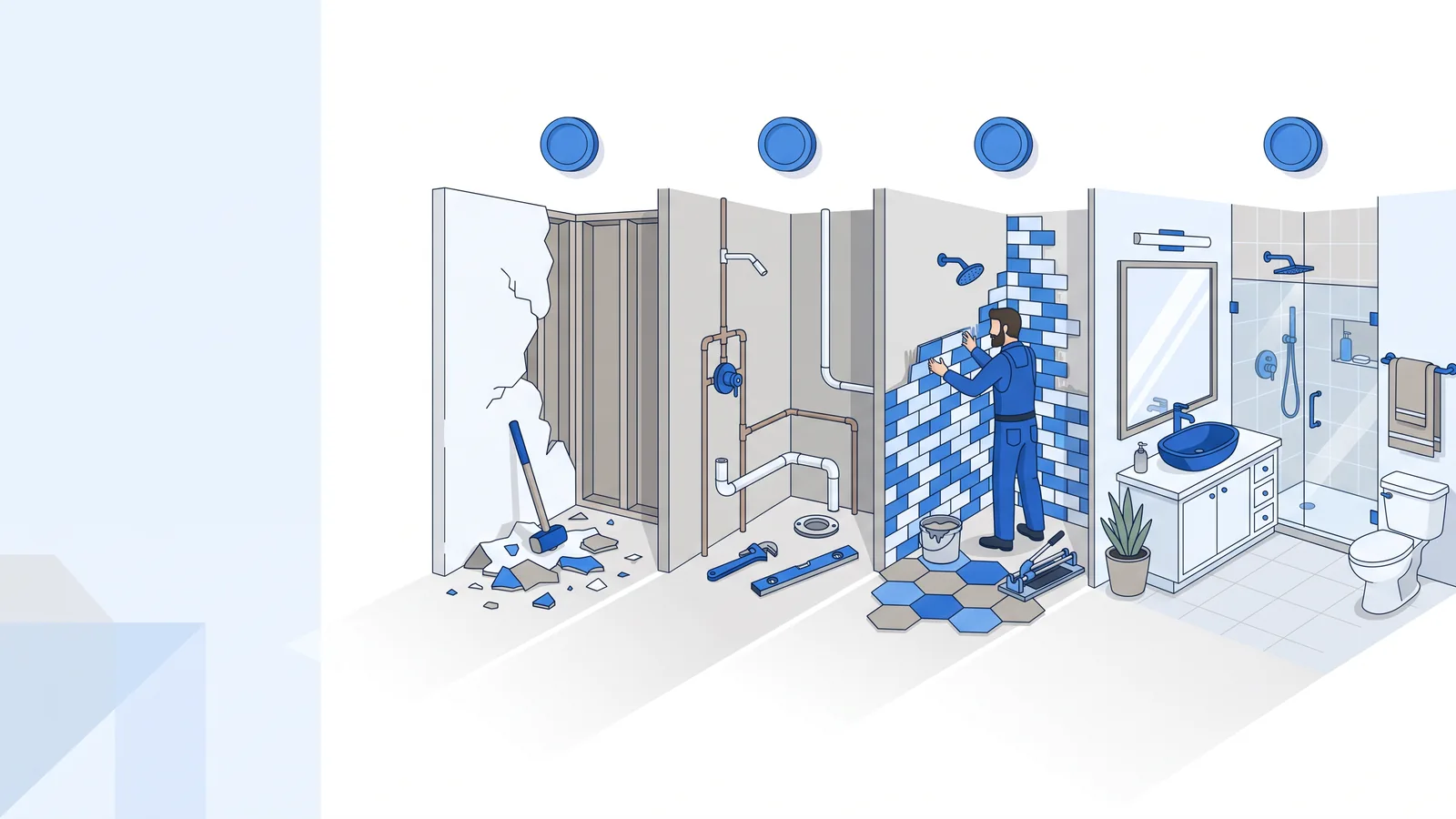
Worked example: a $24,000 bathroom remodel
Say you quote a $24,000 bathroom remodel with a $2,400 deposit at signing. The remaining $21,600 is split across visible stages. This is an example, not a universal deposit amount. Some states cap home-improvement deposits; check the rule for your work.
| Milestone | What the customer can see | Amount | Running total |
|---|---|---|---|
| Contract signed | Approved scope and schedule; deposit invoice issued | $2,400 | $2,400 |
| Materials delivery and demolition complete | Listed materials delivered and existing bathroom removed as scoped | $6,000 | $8,400 |
| Rough-in plumbing and electrical passed inspection | Rough-in work is visible and applicable inspection is passed | $6,000 | $14,400 |
| Tile and fixtures set | Specified tile and fixtures installed in the bathroom | $6,000 | $20,400 |
| Final walkthrough and punch list complete | Walkthrough completed and agreed punch-list work finished | $3,600 | $24,000 |
Check the sum: $2,400 + $6,000 + $6,000 + $6,000 + $3,600 = $24,000. The first four payments total $20,400, leaving $3,600 for completion. Match each description to the actual scope; if no inspection applies, choose a verifiable trigger instead.
Before demolition, compare the first payment with upcoming orders and labor costs. Before rough-in, check that the prior invoice is resolved under the contract. Record any allowance or selection change and update the balance. For deposit sizing and rules, read how much deposit to ask for.
Progress billing against a schedule of values
A schedule of values divides a contract sum into categories such as site preparation, framing, windows, electrical, and finishes. Each line has a value. Each billing period reports work earned to date, prior billings, and the amount requested now.
For a $60,000 addition, assume framing is valued at $18,000 and electrical at $12,000, with other categories making up the rest. This month, $14,000 of framing and $6,000 of electrical are complete, or $20,000 earned to date. Last month, $8,000 of work was billed, with 10% retainage withheld.
For this example, retainage is 10% of completed work billed to date. The contract controls the actual percentage and method. The prior $8,000 billing had $800 held, so its net billing was $7,200. This month adds $12,000 of work. Retainage on that new work is $1,200, leaving $10,800 before subtracting the prior net billing.
| One-month invoice calculation | Amount |
|---|---|
| Completed work to date | $20,000 |
| Less prior gross billings | -$8,000 |
| Current period work before retainage | $12,000 |
| Retainage on current period at 10% | -$1,200 |
| Current amount due | $10,800 |
The $7,200 prior net billing plus $10,800 due now equals $18,000, with $2,000 held on $20,000 earned. Check the billing form’s columns: some forms show prior retainage separately. Don’t deduct a prior billing or retained amount twice.
Use the contract’s retainage percentage and release condition. See the retainage glossary entry. Follow the required project form; the AIA billing overview covers that topic, not G702 or G703 details.
Deposit rules and state limits
Some states cap home-improvement deposits, and the rules also cover how progress payments are held. Don’t assume the example amount is allowed where you work. Check the state contractor licensing board or state attorney general’s consumer protection office for rules that apply to your job type.
A few examples show how much the rules differ. California’s Contractors State License Board says the down payment on a home improvement job can’t be more than $1,000 or 10% of the contract price, whichever is less, so the $2,400 deposit in the example above would be too high there; you would take $1,000 at signing and move the rest into the first progress payment. Maryland caps the deposit at one-third of the contract price. New York has no percentage cap, but its Attorney General says payments received before substantial completion must go into a trust (escrow) account unless the contractor posts a bond, and the progress schedule must bear a reasonable relationship to the work done.
Keep the signed estimate, deposit invoice, receipt, and change approvals in the job file.
Writing the schedule into your estimate or contract
Give the amount, trigger, and due timing for every payment. Percentages without milestone descriptions invite disagreement. Make the total match the contract price and state how tax or other charges are handled.
Adapt this wording and have it reviewed for your location and type of work:
Payment schedule: The contract price is [Contract total]. Customer will pay [Deposit amount] when both parties sign. Customer will pay [Stage amount] when [specific, observable milestone] is complete and Contractor sends an invoice. Customer will pay [Stage amount] when [next milestone] is complete and invoiced. The final payment of [Final amount] is due after [defined completion condition]. Each payment is due [number of days or other agreed timing] after the invoice is delivered. The amounts listed total [Contract total].
Changes: Work outside the listed scope requires written approval describing the work, price, and schedule or payment change before it begins, unless both parties document another process. See how to write a change order.
Billing records: Identify the completed milestone or billed work on each invoice. State any retainage, release condition, or required supporting document in the contract.
For commercial work, attach or identify the schedule of values. State the billing period, cutoff date, submission method, backup, and review process required by the prime contract. The guide to payment terms and cash flow covers invoice timing and the gap between spending and collection.
Invoicing each stage
Invoice when the milestone is complete. Name the job and stage, show the amount due, copy the contract’s due terms, and note prior payments or credits. Add a photo, delivery record, inspection result, or progress detail when it verifies the work.
- Deposit invoice: Tie it to the signed estimate or contract and label it as a deposit. Record the amount received. A deposit invoice should say what the payment covers.
- Progress invoice: Name the completed stage or list schedule-of-values lines and completion. Show prior billings, current work, approved changes, contract retainage, and amount due.
- Final invoice: Show the contract amount, approved additions or credits, payments received, retainage due under the contract, and remaining balance.
- Receipt and closeout: After recording payment, provide a receipt with method and amount. Where used or required, exchange the right lien waiver for the payment and period. Check project requirements for form and timing.
Keep invoices, receipts, approvals, and inspection records together, and track billed, paid and outstanding amounts against the approved contract after every stage. Whatever tool you use should carry the deposit and the itemized scope into each invoice instead of making you retype them. Invocket, for example, turns the accepted estimate into an invoice with the itemized scope carried over, and Duplicate copies an invoice for the next stage; it has no separate deposit or progress invoice type, so name each stage and set its amount yourself; see the construction invoice and estimate app page.
When a milestone payment is late
Check that the milestone is complete under the contract and that the invoice reached the right person. Confirm the amount, due terms, backup, and approval steps. A short message may resolve a missed email or question.
Write down the invoice number, amount, milestone, delivery date, and requested action. For example: “Invoice [Invoice #] for [Milestone] in the amount of [Amount] was sent on [Date]. Please confirm you received it and tell me if backup is missing. Under our agreement, payment is due [Agreed due date].” Don’t threaten action before checking your rights.
If the customer disputes completion, ask which item remains incomplete. Compare it with the written trigger and document site conditions. Separate punch-list work from disputes over added work. Record any agreed correction and update the invoice or timing if needed.
Before starting a costly next phase while a balance is past due, check the contract and contact the customer. The agreement and applicable rules govern pausing work, late fees, and formal notices. See the payment terms and cash flow guide.
FAQ
How many payments should a contractor schedule?
Use enough stages to match major work and costs, but keep billing manageable. A service call may need fewer stages than a multi-phase remodel. Tie each trigger to work the customer can verify.
How do you structure payments for a contractor?
Write the total price, each amount, its milestone, and invoice due timing. Make all amounts add up to the contract total, including deposit and final payment. Check deposit rules for the project location.
Should a contractor charge a deposit before ordering materials?
Plan timing around the purchase and say what the payment covers. Deposit limits vary by state and project, so check applicable rules before quoting an amount. Use the deposit guidance linked above.
What should a progress payment invoice include?
Identify the project and completed milestone or schedule-of-values lines. Show work earned, prior billings or payments, approved changes, contract retainage, and the amount due. Attach required backup.
How much should you leave for the final payment?
Set an amount that reflects remaining work without making it most of the contract. Define completion and punch-list handling in writing. Check that earlier stages cover costs as they come due.

About this page
Invocket Editorial
Written by the team that builds Invocket, an invoicing app for contractors. We check prices and rules against published sources, name them on the page, and update the page when they change. How we write and check these pages.