
In short
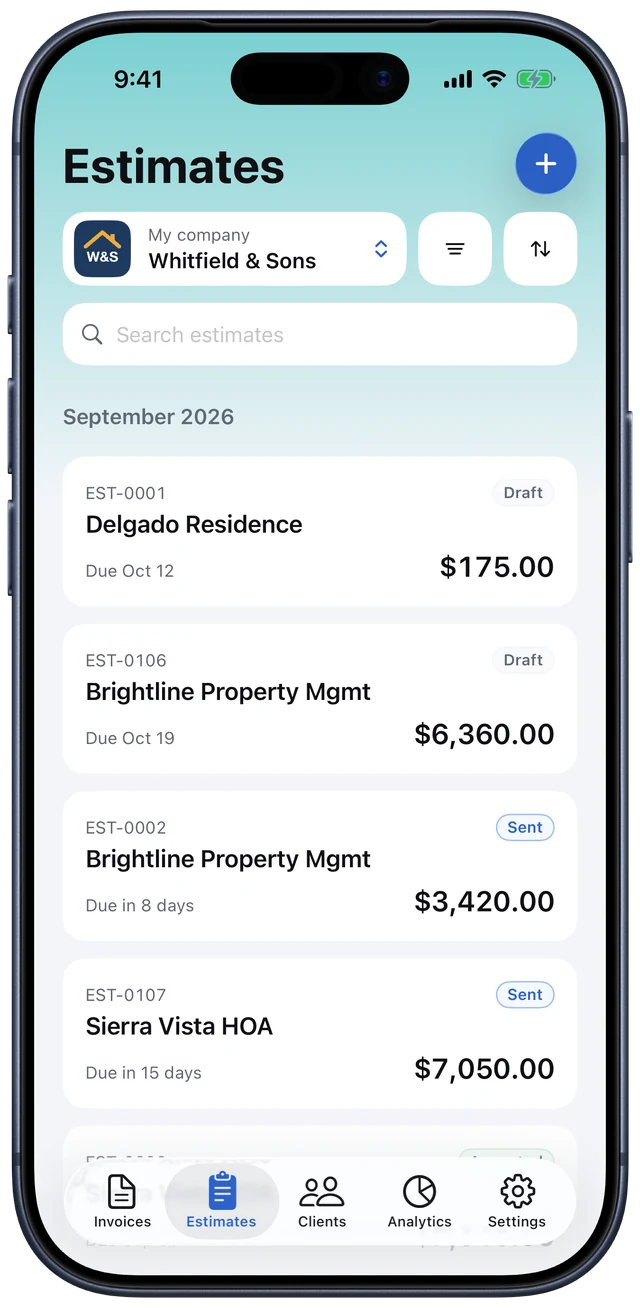
Invocket lets handyman businesses write estimates on site, turn accepted ones into invoices, mark them paid and see who still owes what, all on the iPhone and without signal. Estimate with AI drafts the line items from a description.
On this page
What a handyman job bills like
These are the lines a handyman estimate usually carries. In Invocket each one is a line item with a quantity and a price, and you can group them into sections with their own subtotals:
- Labor, per hour
- Half-day minimum
- Trip charge
- Materials, at cost plus markup
How handyman jobs are priced and paid
Use a flat task price when a repair is clear and inspectable. Bill hourly for troubleshooting or uncertain work, and state the minimum and extra-time terms. A trip charge can cover dispatch and travel; say if it applies per visit or return trip. For a punch list, price a half-day or full-day block when tasks share a visit. Itemize materials at cost plus an agreed markup, or include them in a fixed price. See the handyman rates guide to compare pricing units.
Separate labor, parts, and visit charges so the customer can see what the estimate covers. Common items include:
| Line item | Priced by | What to write on the estimate |
|---|---|---|
| Door adjustment | Per door or labor time | Hinge, latch, alignment, exclusions |
| Faucet repair | Per task plus parts | Repair scope, supplied parts, access |
| Drywall patch | Patch size or labor time | Area, finish level, paint inclusion |
| Shelf installation | Per item | Quantity, mounting surface, hardware |
| Trip or visit minimum | Per visit or time block | What it covers and when it applies |
| Materials and disposal | Receipts, allowance, or bundle | Parts, markup basis, haul-away scope |
For a short visit, collect the agreed balance when work is complete and send an itemized invoice. For a multi-day job, request a deposit for special-order parts, then bill at written milestones such as an approved task group’s completion; credit prior payments against the balance. With commercial customers, confirm purchase order, invoice contact, submission requirements, and payment terms before scheduling. Put due dates and approval steps in writing. Deposit requirements vary, so check state and local rules.
The documents a handyman job produces


What makes billing handyman work harder
A punch list mixes different tasks
A visit may include a sticking door, loose towel bar, and leaking trap, each with different setup time and parts. A vague half-day charge leaves uncertainty if the list runs short or grows. Number each task and state what the visit minimum covers. Before invoicing, mark completed and deferred items on the work ticket.
A short repair still takes a trip
Travel, access, diagnosis, and a parts run can take longer than the repair. If the estimate says only hourly labor, the customer may question a minimum or return trip charge. Before booking, show the trip charge, minimum, and second-dispatch terms. On the invoice, separate dispatch from hands-on labor and note a customer-requested return.
The right part is not on hand
A repair may need an uncommon hinge, valve cartridge, fastener, or finish match. Keep the supplier receipt and tie each part to the job. State whether materials are billed at cost, with an agreed markup, or within an allowance. Get approval before substituting a part that changes fit or appearance, and record returns or credits.
Dispute: The bill exceeds the estimate
This can happen when opening a fixture exposes damage or the customer adds tasks. Before continuing, describe or photograph the condition and write a change order with added labor, parts, price, and schedule effect. Get approval from the person authorized to pay. If questioned later, share the estimate, approval, dated notes, and receipts, and separate extras from original work.
Dispute: A task is said to be unfinished
A phrase like repair door can mean different results to customer and contractor. Define the result and limits in the estimate. On a dated completion sheet, mark each item complete, incomplete, or awaiting parts; use photos where useful and ask the site contact to acknowledge the list. For a callback, document the reported issue, inspection, and agreed remedy.
Plan billing around turnovers and maintenance waves
Handyman work comes year-round, but spring maintenance, rental turnovers, and move-ins or move-outs can bunch small jobs together. Landlords may send long lists for one unit, while property managers need approvals and invoices by address or work order. Keep visits and units distinct, even when parts come from one supply run. In busy stretches, invoice completed work promptly and track parts paid up front against open balances, so paperwork does not pile up after the repairs do.
Handyman invoicing FAQs
How do I quote a handyman punch list?
Inspect the list, group tasks for one visit, and identify quantities, access, and parts. Price defined tasks or a time block, then state the visit minimum, trip charge, exclusions, and approval process for added work. For a landlord, name the unit and separate work orders if requested.
Should handyman work be hourly or flat rate?
Use a flat task price when the repair and finish are clear enough to scope. Hourly billing fits diagnosis or uncertain work; state the rate basis, minimum, and how time is recorded. For mixed small tasks, a visit block can work if you list what it includes.
How much deposit should I ask for on a handyman job?
Base the deposit on parts or initial work you must fund, and state its purpose in writing. Get approval before ordering special materials, then credit the payment on later invoices. Deposit requirements vary, so check your state and local rules before setting terms.
What belongs in a handyman change order?
Describe the added task or concealed condition, work required, parts, added charge, and schedule change. Get written approval from the customer or authorized property contact before continuing. Keep the approved change with the estimate and reference it on the final invoice.
When should a handyman send the final invoice?
For a one-visit repair, send an itemized invoice when agreed work is complete and state payment instructions. For a longer job, bill at written milestones and invoice the final balance after the approved scope is finished. Confirm commercial submission steps and payment terms before work starts.
Does Invocket work for handyman businesses of one?
Yes, it is built for them. There is no seat pricing, no crew scheduling and no account to create; the app opens straight into an empty ledger on your iPhone.
Can I send a handyman estimate and turn it into an invoice?
Yes. Estimates have their own numbering. When the customer accepts, mark the estimate Accepted and convert it: a new invoice opens with the client, line items, sections, VAT and payment details already filled in, and you save it.
Does it work without a signal?
Yes. Documents are written to the phone, so creating, editing, rendering the PDF and marking an invoice paid all work with no connection. You need a signal to email the file and to use Estimate with AI.

About this page
Invocket Editorial
Written by the team that builds Invocket, an invoicing app for contractors. We check prices and rules against published sources, name them on the page, and update the page when they change. How we write and check these pages.
Keep going
Template
Handyman invoice template
Fill it in on the site or download it.
Template
Handyman estimate template
Line items, deposit and expiry date laid out.
Free tool
Invoice generator
Make a PDF invoice in the browser.
Free tool
Job profit & margin calculator
See what the job leaves you after costs.
Free tool
Markup calculator
Free tool
Labor cost calculator
In the app
Estimate with AI
Academy
Estimates that win the job
Price the job first